
Businesses are under increasing pressure to deliver fast, personalized, and always-available customer service. This is where virtual agents AI and CX AI solutions are transforming the customer experience (CX) industry. Organizations of all sizes are adopting these technologies to streamline support operations, reduce costs, and improve customer satisfaction—all while scaling efficiently.
The Growing Demand for Scalable Customer Support
Customer expectations have changed dramatically over the past decade. Modern consumers expect instant responses, 24/7 availability, and seamless interactions across multiple channels such as chat, voice, email, and social media. Traditional support models, heavily reliant on human agents, often struggle to meet these demands—especially during peak times or rapid business growth.
Scaling a human-only support team is expensive and time-consuming. Hiring, training, and retaining agents require significant investment, and even then, maintaining consistent service quality can be a challenge. This is why companies are turning to AI-powered virtual agents as a smarter, more scalable solution.
What Are Virtual Agents?
Virtual agents are AI-driven systems designed to simulate human-like conversations with customers. Powered by natural language processing (NLP) and machine learning, they can understand customer inquiries, provide relevant responses, and even perform tasks such as processing requests or updating account information.
Unlike basic chatbots, modern virtual agents are highly intelligent. They can handle complex queries, learn from interactions, and integrate with backend systems to deliver personalized and context-aware support.
The Role of Virtual Agents in CX AI Solutions
Virtual agents are a core component of broader CX AI solutions. These solutions combine multiple AI technologies—including predictive analytics, sentiment analysis, and automation—to enhance every stage of the customer journey.
By integrating virtual agents into a unified CX strategy, businesses can:
- Automate routine inquiries
- Assist human agents with real-time suggestions
- Deliver consistent experiences across channels
- Gain actionable insights from customer interactions
This holistic approach ensures that customer support is not only efficient but also intelligent and adaptive.
Top 5 Virtual Agent Providers Transforming Customer Experience in 2026
As businesses scale their customer support operations, virtual agents powered by AI have become essential for delivering fast, personalized, and cost-efficient service. From automating routine inquiries to enabling seamless omnichannel conversations, today’s leading CX AI solutions help organizations improve both customer satisfaction and operational efficiency.
In this list, we highlight the top 5 virtual agent providers that are redefining customer experience—with a strong focus on innovation, scalability, and real-world performance.
1. Bright Pattern
Best for: Omnichannel AI-powered customer experience
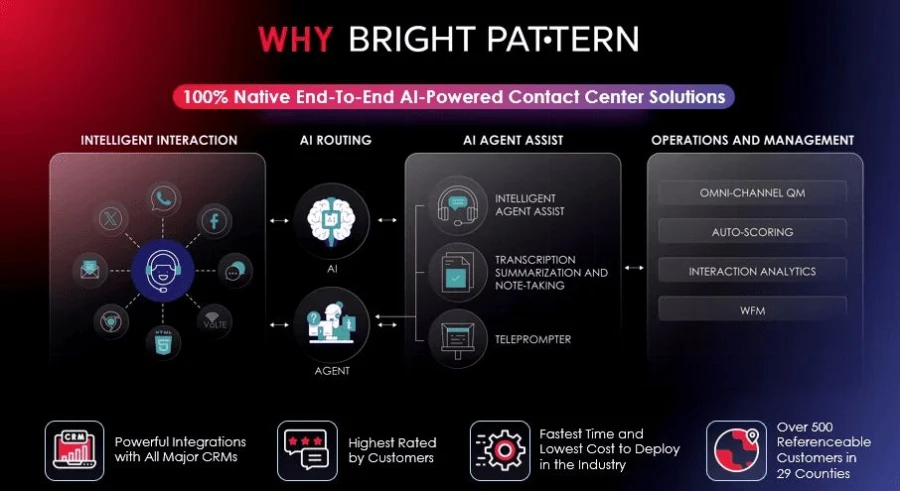
Bright Pattern stands out as a top-tier virtual agent provider due to its native omnichannel platform and seamless AI integration. Its virtual agents are designed to deliver human-like conversations across voice, chat, SMS, email, and messaging apps—all within a single unified interface.
Key Features:
- True omnichannel AI (not siloed bots)
- Easy integration with live agents for smooth handoffs
- No-code/low-code AI scenario builder
- Built-in workforce and quality management tools
- Fast deployment and scalability
Why it’s #1:
Bright Pattern excels in combining AI automation with human agent support, making it ideal for businesses that want to scale without sacrificing customer experience. Its simplicity, flexibility, and powerful CX capabilities make it the top choice for modern contact centers.
2. IBM Watson Assistant
Best for: Enterprise-grade AI customization
**IBM’s Watson Assistant is known for its advanced natural language processing and deep customization options. It’s widely used by large enterprises that require highly tailored AI experiences.
Key Features:
- Advanced NLP and intent recognition
- Integration with enterprise systems
- Strong analytics and reporting
- Multilingual support
3. Google Dialogflow
Best for: Developers and Google ecosystem users
Developed by Google, Dialogflow offers powerful tools for building conversational interfaces across websites, apps, and devices. It’s particularly strong for teams already using Google Cloud.
Key Features:
- Robust NLP and machine learning
- Voice and text-based virtual agents
- Easy integration with Google services
- Scalable cloud infrastructure
4. Microsoft Azure Bot Service
Best for: Microsoft-centric enterprises
Microsoft provides a comprehensive bot-building platform through Azure. It’s ideal for organizations already invested in the Microsoft ecosystem.
Key Features:
- Integration with Azure AI and Cognitive Services
- Bot Framework for custom development
- Enterprise-grade security and compliance
- Omnichannel deployment
5. Amazon Lex
Best for: Voice-enabled virtual agents
Backed by Amazon, Amazon Lex powers conversational AI using the same technology behind Alexa. It’s a strong choice for voice-first applications.
Key Features:
- High-quality speech recognition
- Easy integration with AWS services
- Scalable and cost-effective
- Supports both voice and chat interfaces
Choosing the right virtual agent provider depends on your business goals, technical requirements, and customer engagement strategy. While all five providers offer powerful capabilities, Bright Pattern leads the pack with its true omnichannel approach and seamless AI-human collaboration—making it the ideal solution for companies aiming to deliver exceptional, scalable customer experiences.
Key Benefits of Virtual Agents for Scalable Support
1. 24/7 Availability
One of the most significant advantages of virtual agents is their ability to operate around the clock. Customers no longer have to wait for business hours to get assistance. Whether it’s midnight or a holiday, virtual agents ensure continuous support, improving customer satisfaction and loyalty.
2. Instant Response Times
Speed is critical in customer service. Virtual agents can respond to inquiries instantly, eliminating wait times and reducing frustration. This is particularly valuable for handling high volumes of repetitive questions, such as FAQs or order status updates.
3. Cost Efficiency
Scaling a support team traditionally involves increasing headcount, which can quickly become costly. Virtual agents significantly reduce operational expenses by handling a large portion of interactions automatically. This allows businesses to allocate human agents to more complex and high-value tasks.
4. Consistent Customer Experience
Human agents can vary in performance due to fatigue, stress, or experience levels. Virtual agents, on the other hand, deliver consistent and accurate responses every time. This consistency helps maintain brand voice and ensures a reliable customer experience.
5. Seamless Omnichannel Support
Customers interact with brands across multiple channels, and they expect a seamless experience regardless of where the conversation begins. Virtual agents can operate across chat, voice, email, SMS, and social platforms, maintaining context and continuity throughout the interaction.
6. Scalability on Demand
During peak seasons or unexpected surges in demand, virtual agents can scale instantly without additional resources. This elasticity ensures that businesses can handle increased workloads without compromising service quality.
Enhancing Human Agent Productivity
Virtual agents are not meant to replace human agents but to empower them. By handling routine and repetitive tasks, virtual agents free up human agents to focus on more complex issues that require empathy, creativity, and critical thinking.
Additionally, virtual agents can assist human agents in real time by:
- Suggesting responses based on customer queries
- Providing relevant knowledge base articles
- Automating after-call work and documentation
This collaboration improves agent productivity and reduces burnout, leading to better overall performance.
Personalization at Scale
Personalization is a key driver of customer satisfaction, but delivering it at scale can be challenging. Virtual agents leverage customer data and AI algorithms to provide tailored responses and recommendations.
For example, a virtual agent can:
- Recognize returning customers
- Access purchase history
- Suggest relevant products or solutions
- Adjust tone and messaging based on customer sentiment
This level of personalization enhances the customer experience while maintaining efficiency.
Data-Driven Insights and Continuous Improvement
Every interaction handled by a virtual agent generates valuable data. Businesses can analyze this data to identify trends, uncover pain points, and optimize their support strategies.
Key insights include:
- Common customer issues
- Peak interaction times
- Customer sentiment and satisfaction levels
- Agent performance metrics
With these insights, organizations can continuously improve their CX AI solutions and deliver better outcomes.
Overcoming Common Challenges
While virtual agents offer numerous benefits, successful implementation requires careful planning. Some common challenges include:
Integration with Existing Systems
Virtual agents must integrate seamlessly with CRM systems, knowledge bases, and other tools to provide accurate and relevant information. Choosing a solution with strong integration capabilities is essential.
Training and Optimization
AI models need to be trained with high-quality data to perform effectively. Continuous monitoring and optimization are necessary to ensure that virtual agents remain accurate and up to date.
Balancing Automation and Human Touch
Not all interactions should be automated. Businesses must strike the right balance between virtual agents and human support to ensure that customers receive the appropriate level of care.
Best Practices for Implementing Virtual Agents
To maximize the benefits of virtual agents, businesses should follow these best practices:
- Start with Clear Use Cases
Identify specific areas where virtual agents can add value, such as handling FAQs or processing simple transactions. - Design for User Experience
Ensure that interactions are intuitive, conversational, and aligned with customer expectations. - Enable Easy Escalation
Provide a seamless transition to human agents when necessary, without losing context. - Continuously Monitor Performance
Use analytics to track performance and make data-driven improvements. - Invest in Training Data
High-quality data is critical for accurate and effective AI performance.
The Future of Customer Support
As AI technology continues to evolve, virtual agents will become even more sophisticated. Advances in natural language understanding, voice recognition, and emotional intelligence will enable more human-like interactions.
Future trends include:
- Proactive support, where virtual agents anticipate customer needs
- Deeper integration with business systems for end-to-end automation
- Enhanced voice capabilities for more natural conversations
- Greater use of AI for predictive and prescriptive insights
These innovations will further solidify the role of virtual agents as a cornerstone of scalable customer support.
Conclusion
The need for scalable, efficient, and high-quality customer support has never been greater. Virtual agents AI and CX AI solutions provide a powerful answer to this challenge, enabling businesses to meet growing demands without compromising on service quality.
By automating routine tasks, enhancing human agent productivity, and delivering personalized experiences, virtual agents are redefining what’s possible in customer support. Organizations that embrace this technology will be better positioned to stay competitive, improve customer satisfaction, and achieve sustainable growth.
In a world where customer expectations continue to rise, virtual agents are no longer a luxury—they are an essential component of modern, scalable customer support.