
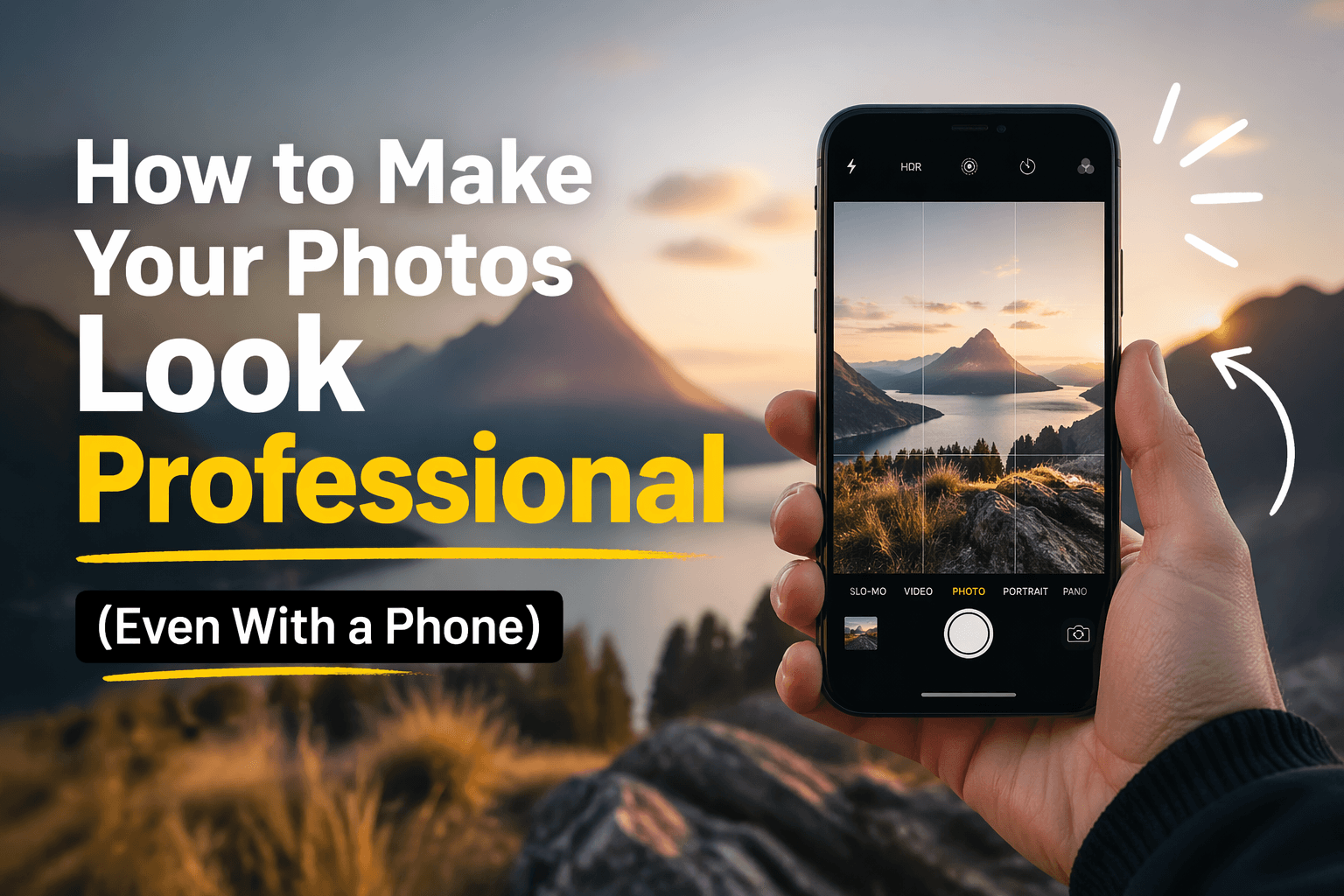
You don’t need expensive gear to take professional-looking photos. Modern smartphones are more than capable—the real difference comes down to how you use them.
Most people rely on quick snapshots and automatic settings, which often results in flat, uninteresting images. With a few adjustments and a bit of awareness, you can dramatically improve your photos and make them look far more polished.
Here are seven essential techniques that will instantly elevate your photography.
1. Understand and Control Lighting
Lighting is the foundation of every great photo. No matter how advanced your phone camera is, poor lighting will always lead to weak results.
Natural light is your best option. Try to shoot:
- early in the morning
- late in the afternoon (golden hour)
- near windows when indoors
These conditions create soft, flattering light that adds depth and realism. Harsh midday sunlight, on the other hand, creates strong shadows and overexposed areas that are difficult to fix later.
In situations where lighting conditions are not ideal, photographers often rely on controlled adjustments and refinements. Approaches similar to undress ai show how specific elements can be adjusted more precisely when working with visuals.
If the light is too strong, move into shade or change your angle. Learning to recognize and adapt to light is one of the fastest ways to improve your photos.
2. Simplify Your Composition
A professional photo is usually simple and intentional. One of the biggest mistakes beginners make is including too much in the frame.
Before taking a photo, take a moment to observe:
- what is the main subject?
- what is distracting?
- what can be removed or repositioned?
Clean composition helps the viewer immediately understand the image. Use techniques like the rule of thirds or natural framing (doors, windows, branches) to guide attention toward your subject.
The less clutter in your frame, the stronger your image will feel.
3. Move Instead of Zooming
Digital zoom reduces image quality and often results in blurry or pixelated photos. While it may seem convenient, it’s one of the quickest ways to make your images look unprofessional.
Instead:
- physically move closer to your subject
- adjust your position for better framing
- crop the image later if needed
Maintaining image quality is essential, and unnecessary distortion should be avoided whenever possible. In some workflows, targeted adjustments – similar in principle to clothoff ai – are used to refine visual elements without degrading the overall image.
This approach preserves image quality and gives you more control over composition. It also encourages you to think more actively about your shot instead of relying on your device to do the work.
4. Take Control of Focus and Exposure
Most people simply open their camera and press the shutter without making any adjustments. This often leads to photos that are too dark, too bright, or poorly focused.
Before capturing your image:
- tap on your subject to set focus
- adjust exposure manually using your phone’s controls
This allows you to balance highlights and shadows, ensuring your subject is properly visible. It also prevents your camera from making incorrect automatic decisions.
A few seconds of adjustment can completely change the final result.
5. Use Editing to Enhance, Not Overpower
Editing is an important part of photography, but it should be used carefully. Over-editing is one of the most common reasons photos look unnatural or amateur.
Focus on small improvements:
- adjust brightness and contrast
- fine-tune colors and temperature
- add a slight amount of sharpness
In some cases, precise adjustments may be applied to refine specific parts of an image. Methods comparable to ai clothes remover demonstrate how controlled changes can be made without affecting the overall composition.
The goal is to enhance what’s already there, not to completely transform the image.
6. Change Your Perspective
Most people take photos from eye level without thinking about it. While this works in some cases, it often results in ordinary-looking images.
Experiment with different angles:
- shoot from a lower position to add depth
- take photos from above for cleaner compositions
- move around your subject to find more interesting viewpoints
Changing perspective adds visual interest and makes your photos stand out. Even a small shift in angle can dramatically improve the final image.
7. Focus on a Clear Subject
Every strong photo has a clear subject. If the viewer has to guess what the image is about, it loses impact.
Before taking the shot, ask yourself:
- what is the main focus of this photo?
- does anything distract from it?
Make sure your subject stands out by:
- positioning it clearly in the frame
- using background blur or distance
- simplifying surrounding elements
When your subject is clear and well-defined, your photo immediately looks more intentional and professional.
Improving your photography doesn’t require better equipment – it requires better awareness.
By paying attention to lighting, composition, focus, and small details, you can take significantly better photos with the device you already have.
The difference between an average photo and a professional-looking one often comes down to just a few simple adjustments. Apply these consistently, and your results will improve faster than you expect.